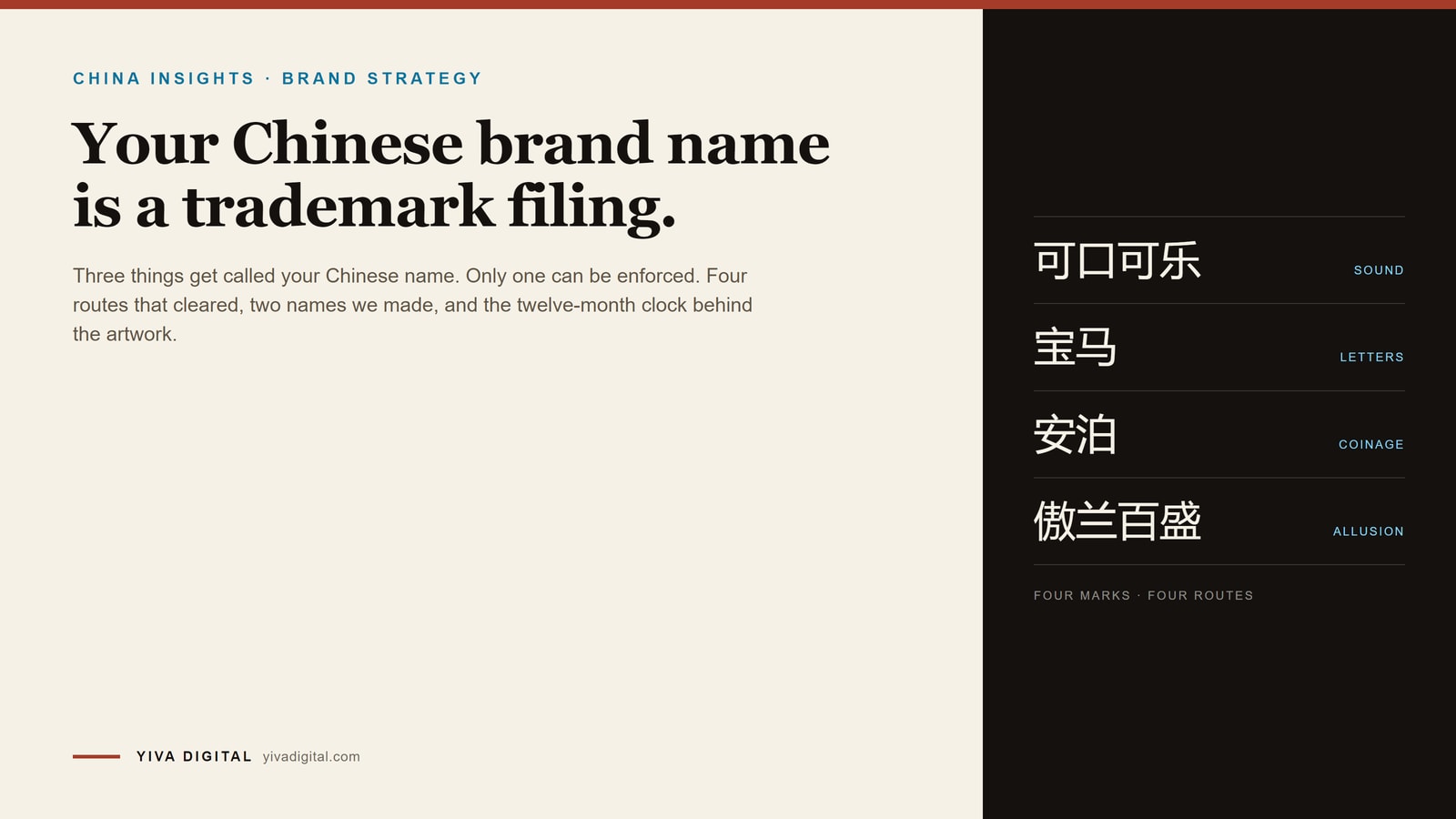
Your Chinese brand name is a trademark filing
Three things get called your Chinese name, and only one of them can be enforced. How 可口可乐, 宝马 and 宜家 cleared the register, the two names we made for clients, and the twelve-month clock behind the artwork.
On the boot lid of a BMW assembled in Shenyang sit two names. On the left, 华晨宝马 — Brilliance BMW, the joint venture that built the car. In the middle, the roundel: what the company sells under everywhere.
The prefix is not a branding decision. A regulation that took effect in February 2006 requires the Chinese name of the manufacturer on the rear of every car built in the country, in a specified size and material; imports are exempt. The manufacturer here is a company registered in Shenyang, and 华晨 is the Chinese partner, Brilliance. So the company's registered name goes on the boot lid beside the mark, and BMW can drop neither one.
One of those strings is registered with a market regulator, and holds only inside a region and a trade. The other is filed with CNIPA, class by class, and holds across the country. A brand can lose the first and keep the second, and the second is the one worth paying a lawyer for.
Two assets share the phrase "your Chinese name". Most companies only ever notice the first.
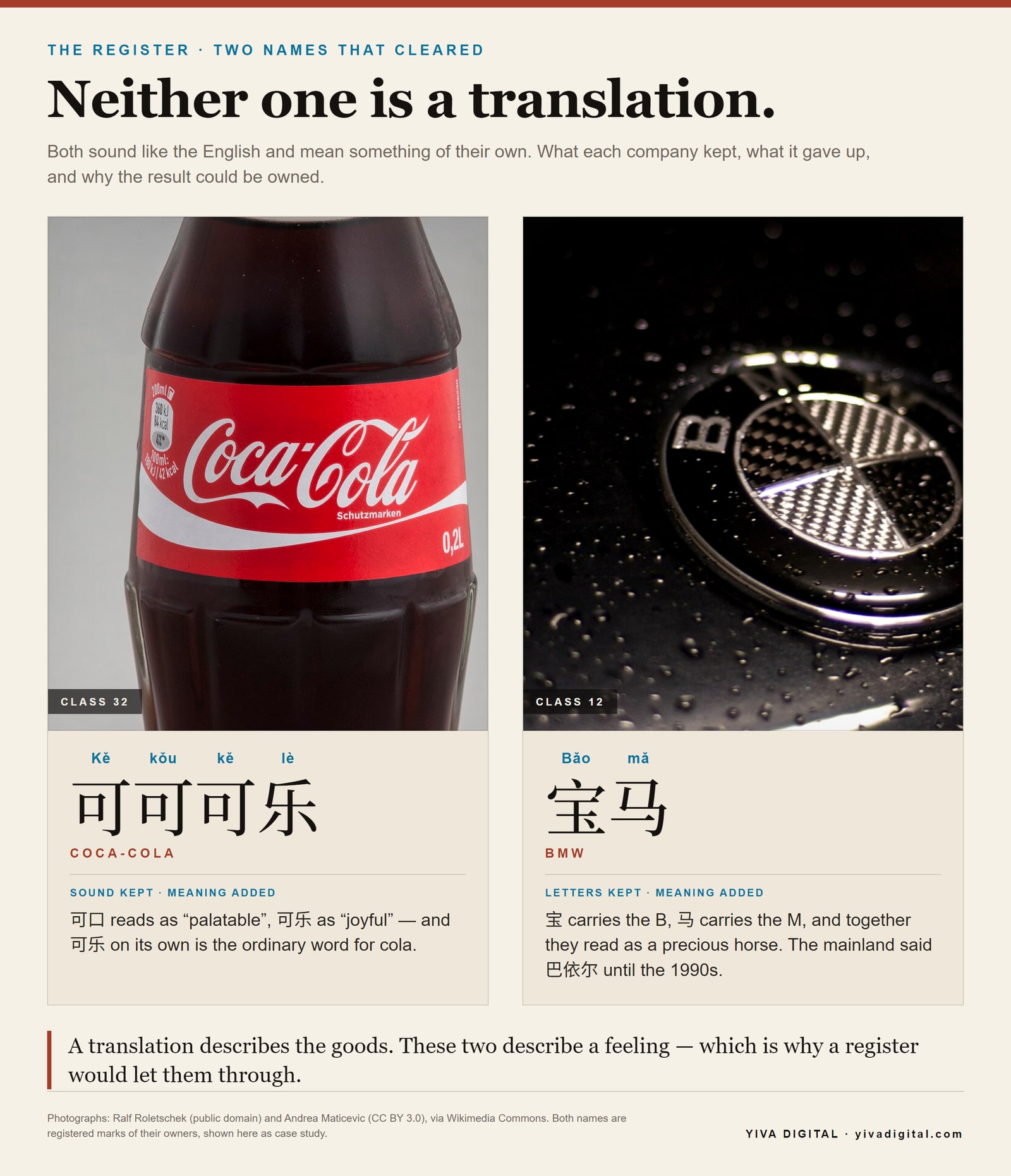
Two marks that cleared. Neither is a translation: both keep the sound of the English and add a meaning of their own.
Three things get called your Chinese name
Ask a management team what their Chinese name is and the answer depends on who in the room replies.
- The transliteration. What the receptionist says when the phone rings, what the distributor writes on a WeChat quote. Nobody owns it.
- The name on the business licence. 企业名称, registered with the local market regulation authority when the entity was set up. The exclusive right covers that administrative region and, in the ordinary case, that industry.
- The mark on the packaging. 商标, filed separately with CNIPA, one application per class, ten years at a time, renewable.
Only the third travels. It is the one you can license, defend, seize in a customs action, and carry on a balance sheet as an asset.
Coca-Cola's Chinese mark is 可口可乐: four characters, filed in the class that covers non-alcoholic drinks. Note what the company does not own. 可乐 alone is the ordinary Chinese word for cola; the generic term belongs to the language. The specific four characters belong to whoever filed them first and renews them.
That is the shape of the asset. A translation describes; a trademark is filed.
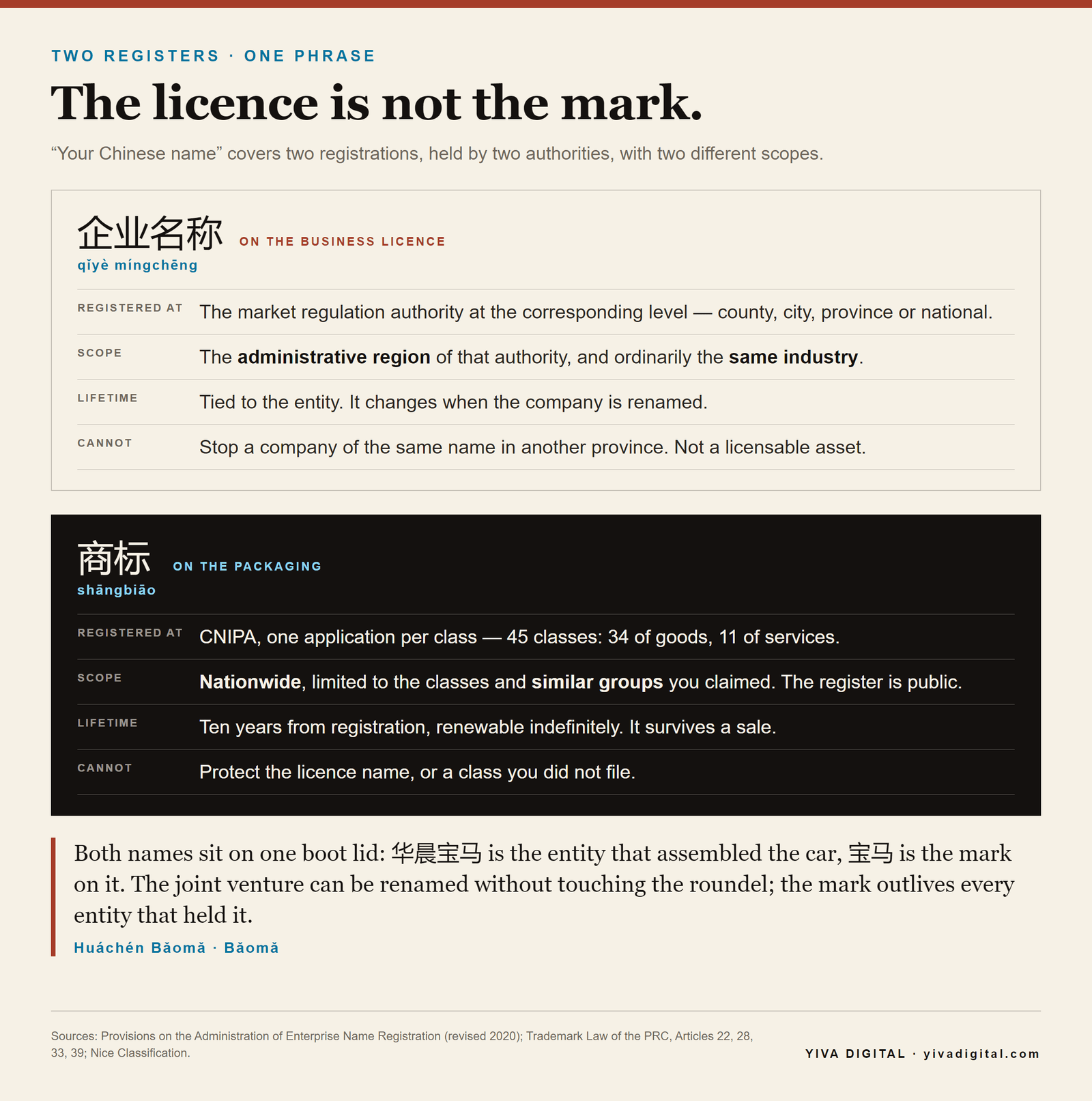
The enterprise name is registered regionally, the trademark nationally, class by class. A car can carry both at once: the badge names the company, the roundel names the mark.
The statute will not let you own a description
Article 11 of the Trademark Law of the People's Republic of China lists what cannot be registered: signs consisting only of the generic name, design or model of the goods, and signs that directly indicate quality, main raw material, function, use, weight, quantity or other characteristics.
Read it as a list of the names marketing teams like. "Pure Silk" for a silk scarf. "Fresh Juice" for juice. "Yunnan Tea" for tea from Yunnan. Each describes the product accurately, which is the problem: a mark that describes the goods leaves a competitor no way to describe theirs, so the law keeps it in the public domain.
There is a second paragraph. A mark that would otherwise be refused can be registered if it has acquired distinctiveness through use and is easy to identify. That route exists, and it needs years of evidence — sales, advertising, invoices, consumer surveys — assembled in Chinese, for China. For a brand that has not launched, it is not a route.
So the meaning you want to preserve is often the meaning the register will not let you own. The translation that reads best in a boardroom is routinely the one the examiner refuses.
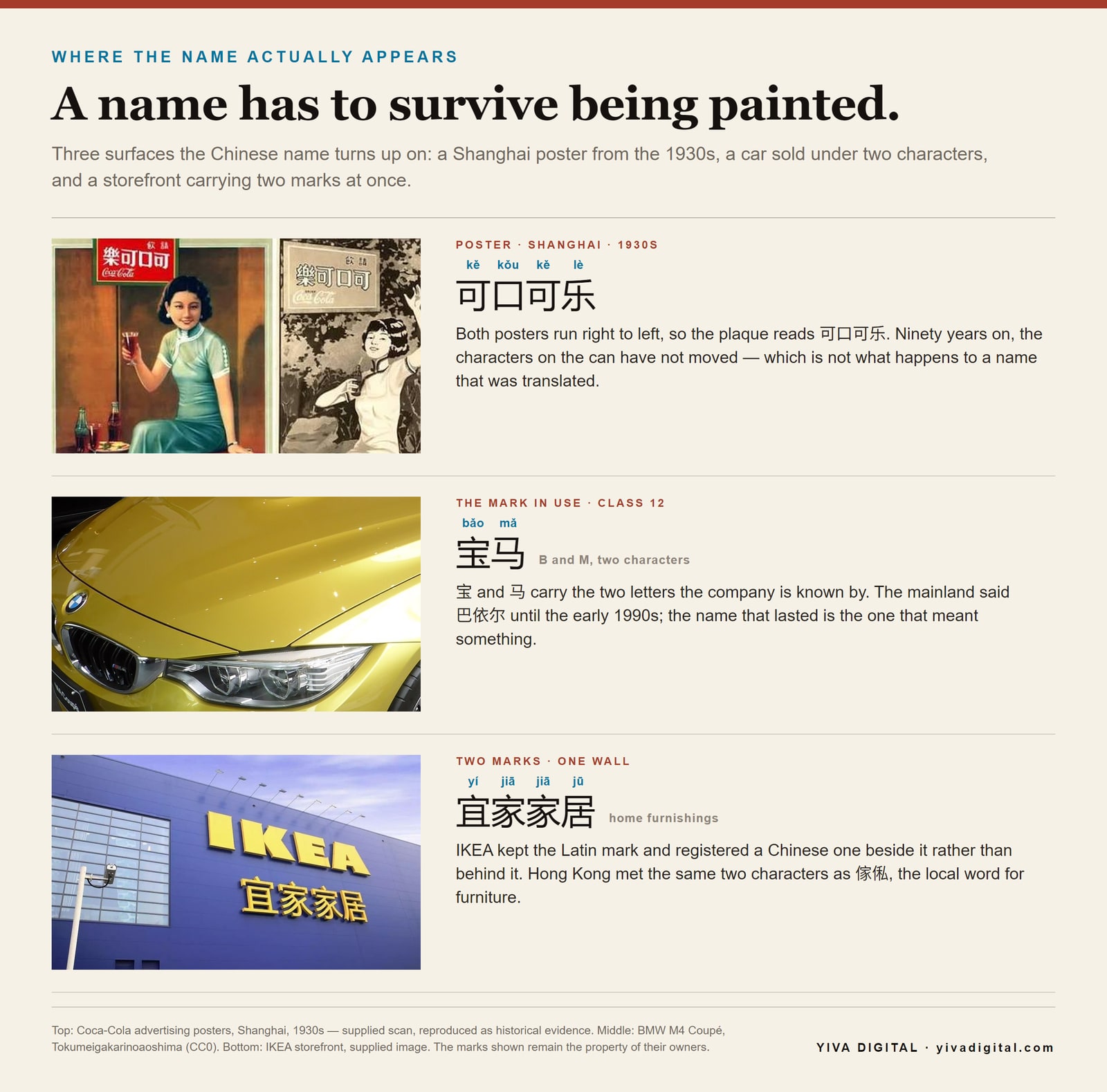
A painted plaque, a stamped badge, two marks on one wall. The same asset seen from the street instead of from the register.
Four routes that cleared
The brands that got this right did not translate. Each made a decision about what to keep, and paid for it.
Sound, with meaning attached — 可口可乐
可口 reads as "palatable", 可乐 as "joyful" — and 可乐 is also the everyday word for cola. The sound sits close enough to Coca-Cola to survive a radio ad, and the characters add a meaning the English never had. A phonetic rendering that happens to mean something pleasant is the rarest outcome in naming, and the one most often claimed after the fact.
The famous story about this name does not hold up, and it is worth knowing why. The conference version: Coca-Cola entered China in 1927 as 蝌蚪啃蜡, "tadpoles gnawing wax", sold badly, and fixed it with a £350 contest run by The Times and won by the London-based writer 蒋彝. The Chinese-language record on 可口可乐 sets out the difficulties. 可口露 and 可口汽水 were already in use in the 1920s. 蒋彝 did not reach London until 1933, while printed 可口可乐 appears by 1930. The Times, a British paper, had no evident reason to run a Chinese naming contest. The anecdote survives because it flatters a comfortable instinct: that a brand fails abroad because its name was translated badly.
What survives from that period is on a wall, not in a naming brief. The two posters at the top of the figure above are Shanghai advertising from the 1930s: 可口可乐, set right to left as 樂可口可, on a plaque above a woman holding a glass of it. No contest, no £350, no British newspaper — painted tin and a calendar-poster face. The name was already Chinese, already printed, already selling. Ninety years on, the four sounds are unchanged; only the character forms were simplified in 1956. That continuity is the asset: not a better translation, but a name somebody can hold.
Letters, with the meaning replaced — 宝马
宝 ("precious") and 马 ("horse") carry the B and the M. Two characters, and the brand reads as a good horse rather than a Bavarian engine works. BMW has confirmed the earlier name itself: in the early 1990s the mainland called the brand 巴依尔, a transliteration of Bayerische, and the company's 2021 film 《巴依尔的春节》 is built on the fact that nobody remembered it. The letters stayed; the meaning was replaced. That is the opposite move to translation.
Meaning, market by market — 宜家
IKEA's Chinese name is the cleanest example of the move, because there is nothing in the Latin name to translate. IKEA is an acronym: Ingvar Kamprad, Elmtaryd, the family farm, Agunnaryd, the parish. Four letters, no meaning, no picture in the reader's head.
So the company invented one. 宜家 reads as "suits the household" — 宜, to be fitting, 家, home — and says nothing about flat-pack. Hong Kong met the name in 1975 as 宜家傢俬, with 傢俬, the local word for furniture, doing the category work. The mainland, from 1998, got 宜家家居. Same two characters, different second half, because the two markets do not use the same word for what the shop sells.
The internet supplies a better story: that 宜家 comes from 宜室宜家, a line in the Book of Songs blessing a new marriage. It is a lovely fit and there is no evidence for it — not in the company's own account of the name, not in the register. It is the Coca-Cola contest again, in a different century: a good name must be given a story, and the story is usually Chinese, classical and invented afterwards.
One of the most disciplined brand owners in the world runs two Chinese names for one shop, because a name is a filing decision, filings are territorial, and the word for furniture changes when you cross a border.
Allusion — 露华浓
Revlon's Chinese name comes from a line in Li Bai's 《清平调》: 云想衣裳花想容,春风拂槛露华浓. Roughly: the clouds want her clothes, the flowers want her face; the spring wind brushes the railing, the dew lies heavy on the blossom. Revlon reached Hong Kong in 1962 and the mainland in 1996 under that name. In class 3, among cosmetics, "heavy dew on the blossom" describes nothing and evokes everything, which is the space a distinctive mark needs. The cost is a copywriter who knows the canon, and a search confirming that nobody filed the line first.
Coinage — the two names we made
Both client names below are coinages: strings that meant nothing in Chinese until the brand put them to work. The reasoning is the part that travels.
AmberStudents → 安泊
The brief: a student accommodation platform entering China, running university recruitment campaigns and a WeChat mini-program, with a Latin name carrying a colour and a noun. Neither travels. "Amber" is a stone; "student" names the customer.
安泊 keeps the opening sound — 安 (ān) standing in for "Am-" — and adds a meaning the English did not have. 安 is safe, settled, untroubled. 泊 is to moor: a boat coming to rest at a berth. Student housing is a berth for one term, and two characters say it without a landlord's vocabulary.
Three consequences, in the order they mattered. Both characters sit inside the 3,500 most common, so a student types them without scrolling a picker. The string carries no unlucky homophone in Mandarin or Cantonese. And it fits a mini-program tile without an ellipsis.
What it gives up: 安泊 says nothing about amber. If the brand ever wants the colour story, the Chinese name will not carry it and the visual identity has to do that work alone.
Orchid Blossom Arts → 傲兰百盛
A different brief. A London arts organisation — exhibitions at Kew, a film festival on the Thames, short courses with Christie's — that needed to read as an institution to a Chinese partner rather than as a translation of one.
傲兰 is "proud orchid": 兰 is the flower, and one of the four gentlemen of Chinese painting, so it arrives with provenance. 百盛 renders "blossom" as an event rather than a botanical fact — a hundred flourishing, the way 百花盛放 describes everything coming into flower at once.
The four-character length is the point. Chinese institutions use four characters; imported brands usually arrive in two or three and read as imported. 傲兰百盛 sits in a list beside 故宫博物院 without a visible seam.
The trade: two characters of meaning nobody asked for, and one piece of housekeeping. 百盛 is also Parkson's name in mainland retail. A string containing it is not automatically blocked — different trade, and often a different class — but a four-character name has to answer for its neighbours, and the class 35 search is where that question gets settled. Before the artwork, not after.
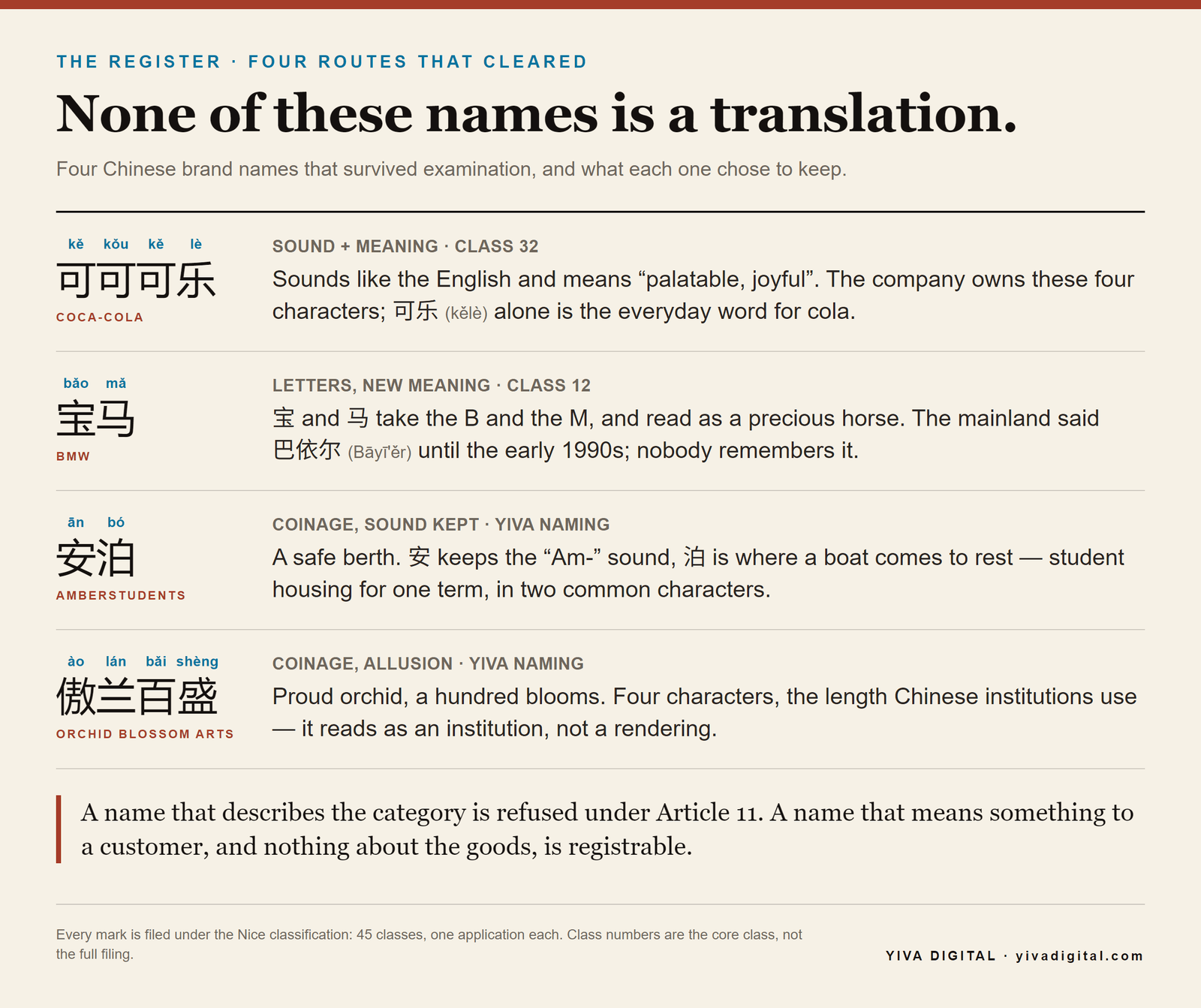
Four marks that cleared examination, and what each one kept. Class numbers are the core class, not the full filing list.
The register is public, and the class is the unit
China follows the Nice Classification: 34 classes of goods, 11 of services, 45 in total. Article 22 requires a separate application for each class. Inside a class, the registration protects the similar groups you claimed, and only those.
Two consequences surprise teams used to a single filing.
The first is the cost shape. A name that appears on packaging, in an app, above a door and in a service contract may need three or four classes. Each one is a fee, an examination and its own queue.
The second is that anyone can read the register. A competitor can pull your filing, see which classes and similar groups you claimed, and file the ones you left open. Article 31 awards the mark to the earlier application, so the gap you left is an invitation with a date on it.
Which is why the announcement and the filing should not share a week. Announce first and you have published a list of the names you have not yet protected.
The clock
Article 28 gives the examiner nine months from filing. Article 33 adds three months after publication for oppositions. A clean application therefore runs about twelve months to registration, before formalities and any office action.
Everything downstream queues behind it: packaging artwork, store signage, the app store listing, the Tmall store name, the creator contracts that name the brand in the deliverable. A rejection does not pause that queue. It sends the name back to the start of it, with the packaging already printed.
One piece of leverage. File at home first and the Paris Convention gives you six months to file in China on the earlier date. That buys time to run the register search properly, and it is the cheapest item on this list.
What we test before the artwork
- Register search, twice. Exact and similar marks in the class you need, then in the similar groups you will actually use. Then a sweep of the obvious adjacent classes for the same string.
- Pinyin search. Type the name as pinyin, no tones and no characters chosen, and read the results. When a name needs a picker, the pinyin string is what people type — and whoever owns that string owns the search.
- Homophone audit. Say the characters aloud in Mandarin and in the two or three other varieties your market uses. Check each character alone as well as the pair.
- The one-hearing test. Say the name once to someone who has never heard of the brand. Can they type it? If not, the name will cost impressions for as long as it lives.
- Character frequency. Both characters inside the first 3,500? A name that needs teaching charges rent at every touchpoint, forever.
None of this is exotic. What the five have in common is that each is cheaper now than after the print run.
What a registered mark does not do
It does not create demand. A well-registered name on a product nobody wants is still a bad name, and the register will not rescue it. It does not stop a similar name; enforcement is a separate budget, a separate filing history and usually a separate lawyer. And it does not travel: a Chinese registration protects you in China, a home registration protects you at home, and neither one reaches the other.
What it does is turn a word into an asset with a date, an owner and a scope. That is the whole difference between the name on the licence and the name on the box.
If the name goes on packaging in March, the filing is due now. It is the cheapest decision to take early and the most expensive to take twice.